
 ,
Samuel Tergunwa Temaugee,
Abubakar Idris Dangana,
Alimi Taofeek,
Umar Abubakar
,
Samuel Tergunwa Temaugee,
Abubakar Idris Dangana,
Alimi Taofeek,
Umar Abubakar
This study set out to address the issue of having cost effective and environmental benign material as absorber layer of thin film solar cells. Thus, the study reported the results of some surface characterization of optimized two-electrode electrochemical deposited Tin-(II)-Sulphide (SnS) thin films. The films were prepared from analytical grade chemical salts of tin (II) tetraoxosulphate (VI) [SnSO4] and sodium thiosulphate pentahydrate [Na2S2O3.5H2O]. They were deposited on ITO coated glass. Some samples were annealed in a Carbonite cylindrical tube furnace at 350°C for one (1) hour under an inert argon atmosphere. The samples (as-deposited and annealed) were then characterized using X-Ray Diffraction (XRD) for structural analysis while surface morphology was determined using Scanning Electron Microscopy (SEM). The data obtained were analyzed using Origin version 2018 to obtain diffraction patterns and three dimension (3D) interactive surface plots of the micrographs were performed using ImageJ software. The results reveal that two-electrode electrochemical deposition technique is a suitable technique for depositing optimum SnS for photon absorption and that, both electrolyte concentration and annealing have positive influence on the structure and morphology of the film. The film intensity, crystallinity and phase purification increase with electrolyte concentration while annealing enhance the grain size and surface uniformity of the films. Thus, it was recommended that, the SnS thin films for photovoltaic application should be prepared from optimum electrolyte concentration using two-electrode electrochemical deposition method and annealed at 350°C in inert environment for the fabrication of thin film solar cells.
| Published in | Advances in Materials (Volume 15, Issue 2) |
| DOI | 10.11648/j.am.20261502.11 |
| Page(s) | 27-36 |
| Creative Commons |
This is an Open Access article, distributed under the terms of the Creative Commons Attribution 4.0 International License (http://creativecommons.org/licenses/by/4.0/), which permits unrestricted use, distribution and reproduction in any medium or format, provided the original work is properly cited. |
| Copyright |
Copyright © The Author(s), 2026. Published by Science Publishing Group |
Electrolyte, Annealing, Tin-(II)-Sulphide (SnS), Electrochemical Deposition, Surface Characteristics, Thin Films
Samples/Materials | Sample A | Sample B |
|---|---|---|
SnSO4 | 0.537 g / 250 ml | 2.685 g / 250ml |
Molarity | 0.01 M | 0.05 M |
Na2S2O3.5H2O | 3.102 g / 250 ml | 6.204 g / 250 ml |
Molarity | 0.05 M | 0.1 M |
Applied Voltage | 1.5 A | 1.5 A |
Electrolyte bath pH | 2.5 | 2.5 |
Deposition Period | 1080/18 Seconds/Minutes | 1320/22 Seconds/Minutes |
Sample | Condition | Average Particle Size (µm) | SD | N |
|---|---|---|---|---|
Au | Un-annealed | 95.2 | 260.4 | 59 |
Aa | Annealed | 78.7 | 149.9 | 41 |
Bu | Un-annealed | 108.9 | 6018.6 | 16066 |
Ba | Annealed | 34.4 | 96 | 2040 |
3D | Three Dimension |
Ecd | Electro Chemical Deposition |
ITO | Indium Tin Oxide |
SEM | Scanning Electron Microscope |
XRD | X-Ray Diffractometer |
| [1] | Ajibade, A. A. (2019). National Strategies to Promote Renewable Energy Development: Whither Nigeria? Afe Babalola University Journal of Sustainable Development, Law & Policy, 10, 1, 74 -103. |
| [2] | Bagher, A. M., Vahid, M. M. A. and Mohsen, M. (2015). Types of Solar Cells and Application. American Journal of Optics and Photonics. 3, 5, 94-113. |
| [3] | Boubakri, A., Koumya, Y., Rajira, A., Almaggoussi, A., Abounadi, A., & Achargui, N. (2023). Triethanolamine concentration effect on electrodeposited SnS thin films properties. Journal of Solid State Electrochemistry, 27, 5, 1061–1074. |
| [4] | Bronusiene, A., Barauskiene, I., Popov, A., Zsiros, B., Farkas, A., Plšek, J., & Ancutiene, I. (2024). The Impact of Thermal Treatment on the Structural, Optical and Electrochemical Characteristics of Tin Sulfide Films. Coatings, 14, 10. |
| [5] | Cifuentes, C., Botero, M., Romero, E., Calderón, C., & Gordillo, G. (2006). Optical and structural studies on SnS films grown by co-evaporation. Brazilian Journal of Physics, 36, 1046–1049. |
| [6] | Dekhil, D., Guessas, H., Nouri, A., & Ullah, S. (2023). Annealing effect on the photocurrent response of SnS thin films prepared by the chemical spray pyrolysis method. Chalcogenide Letters, 20, 8, 549–558. |
| [7] | Ganchev, M., Spasova, S., Raadik, T., Mere, A., Altosaar, M. and Mellikov, E. (2023). Rapid Thermal Processing of Kesterite Thin Films. Coatings, 13, 1-14. |
| [8] | Gardinier, C. F., & Chang, L. L. Y. (1978). Phase relationships in the systems Mo-Sn2S, W2Sn2S and Mo2W2S. Journal of the Less Common Metals, 61, 2, 221–229. |
| [9] | Gedi, S., Minnam Reddy, V. R., Alhammadi, S., Park, H., Jang, C., Park, C., & Kim, W. K. (2021). Synthesis and Characterization of π-SnS Nanoparticles and Corresponding Thin Films. Nanomaterials, 11, 3, 767. |
| [10] | Guo, W. (2016). The problem of the overuse of the fossil fuel to produce electricity. School of North China Electric Power University, Bao Ding 5th International Conference on Advanced Materials and Computer Science (ICAMCS 2016), 788-790. |
| [11] | Hassan, T. A. (2016). Thermal Annealing Effects on Characterization of Tin Sulfide Thin Films. 2, 6. |
| [12] | Hegde, S. S., Kunjomana, A. G., Murahari, P., Prasad, B. K., & Ramesh, K. (2018). Vacuum annealed tin sulfide (SnS) thin films for solar cell applications. Surfaces and Interfaces, 10, 78–84. |
| [13] | Jin, L., Duan, K. and Tang, X. (2018). What Is the Relationship between Technological Innovation and Energy Consumption? Empirical Analysis Based on Provincial Panel Data from China. Sustainability, 10, 145. |
| [14] | Kehinde, O., Babaremu, K. O., Akpanyung, K. V., Remilekun, E., Oyedele, S. T. and Oluwafemi, J. (2018). Renewable Energy in Nigeria- A Review. International Journal of Mechanical Engineering and Technology, 9, 10, 1085–1094. |
| [15] | Lasisi, A. R., Babalola O. A., Taleatu, B. A., Alabi, A. B. & Akomolafe, T. (2016) Fabrication and Characterization of Tin Sulphide (SnS) Based Thin Film Solar Cells. Asian Journal of Science and Technology, 7, 11, 3887 - 3890. |
| [16] | Lovchinov, K., Gergova, R., Alexieva, G. (2022). Structural, Morphological and Optical Properties of Nanostructured ZrO2 Films Obtained by an Electrochemical Process at Different Deposition Temperatures. Coatings, 12, 972. |
| [17] | Ma, S., Li, S., Luo, Q., Yu, Z. and Wang, Y. (2024). Revisiting the relationships between energy consumption, economic development and urban size: A global perspective using remote sensing data. Heliyon, 10, 24, 1-15. |
| [18] | Mare, S. D., Menossi, D., Salavei, A., Artegiani, E., Piccinelli, F., Kumar, A., Mariotto, G. and Romeo, A. (2017). SnS thin film solar cells: Perspectives and limitations. Coatings, 7, 2, 34-46. |
| [19] | Mo, Z., Chu, X., Gao, P., Yang, D., Cui, H., Fang, Y., Li, H., Yin, X., & Zhao, Z. (2021). Effect of Continuous Annealing Temperature on the Microstructure, Mechanical Properties and Texture of Annealed Drawn and Ironed Plate. Crystals, 11, 12. Article 12. |
| [20] | Nogami, T., Suzuki, I., Motai, D., Tanimura, H., Ichitsubo, T., & Omata, T. (2025). Non-stoichiometry in SnS: How it affects thin-film morphology and electrical properties. APL Materials, 13, 3, 031115. |
| [21] | Olujobi, O. J. and Olujobi, T. O. (2020). Nigeria: Advancing the Cause of Renewable Energy in Nigeria’s Power Sector Through its Legal Framework. Environmental Policy and Law 50, 433–444. |
| [22] | Reghima, M., Akkari, A., Guasch, C., & Turki-Kamoun, N. (2014). Structure, Surface Morphology, and Optical and Electronic Properties of Annealed SnS Thin Films Obtained by CBD. Journal of Electronic Materials, 43, 9, 3138–3144. |
| [23] | Voznyi, A., Kosyak, V., Grase, L., Vecstaudža, J., Onufrijevs, P., Yeromenko, Yu., Medvid’, A., & Opanasyuk, A. (2018). Formation of SnS phase obtained by thermal vacuum annealing of SnS2 thin films and its application in solar cells. Materials Science in Semiconductor Processing, 79, 32–39. |
| [24] | Wu, K.-J., Tse, E. C. M., Shang, C., & Guo, Z. (2022). Nucleation and growth in solution synthesis of nanostructures – From fundamentals to advanced applications. Progress in Materials Science, 123, 100821. |
| [25] | Zaki, S. A., Abd-Elrahman, M. I., Abu-Sehly, A. A., Shaalan, N. M., & Hafiz, M. M. (2018). Thermal annealing of SnS thin film induced mixed tin sulfide oxides-Sn2S3 for gas sensing: Optical and electrical properties. Materials Science in Semiconductor Processing, 75, 214–220. |
APA Style
Lasisi, A. R., Temaugee, S. T., Dangana, A. I., Taofeek, A., Abubakar, U. (2026). Effects of Electrolyte Concentrations and Annealing on Some Surface Characteristics of Optimised Electrochemical Deposited Tin-(II)-Sulphide (SnS) Thin Films. Advances in Materials, 15(2), 27-36. https://doi.org/10.11648/j.am.20261502.11
ACS Style
Lasisi, A. R.; Temaugee, S. T.; Dangana, A. I.; Taofeek, A.; Abubakar, U. Effects of Electrolyte Concentrations and Annealing on Some Surface Characteristics of Optimised Electrochemical Deposited Tin-(II)-Sulphide (SnS) Thin Films. Adv. Mater. 2026, 15(2), 27-36. doi: 10.11648/j.am.20261502.11
AMA Style
Lasisi AR, Temaugee ST, Dangana AI, Taofeek A, Abubakar U. Effects of Electrolyte Concentrations and Annealing on Some Surface Characteristics of Optimised Electrochemical Deposited Tin-(II)-Sulphide (SnS) Thin Films. Adv Mater. 2026;15(2):27-36. doi: 10.11648/j.am.20261502.11
@article{10.11648/j.am.20261502.11,
  author = {Akangbe Ramoni Lasisi and Samuel Tergunwa Temaugee and Abubakar Idris Dangana and Alimi Taofeek and Umar Abubakar},
  title = {Effects of Electrolyte Concentrations and Annealing on Some Surface Characteristics of Optimised Electrochemical Deposited Tin-(II)-Sulphide (SnS) Thin Films},
  journal = {Advances in Materials},
  volume = {15},
  number = {2},
  pages = {27-36},
  doi = {10.11648/j.am.20261502.11},
  url = {https://doi.org/10.11648/j.am.20261502.11},
  eprint = {https://article.sciencepublishinggroup.com/pdf/10.11648.j.am.20261502.11},
  abstract = {This study set out to address the issue of having cost effective and environmental benign material as absorber layer of thin film solar cells. Thus, the study reported the results of some surface characterization of optimized two-electrode electrochemical deposited Tin-(II)-Sulphide (SnS) thin films. The films were prepared from analytical grade chemical salts of tin (II) tetraoxosulphate (VI) [SnSO4] and sodium thiosulphate pentahydrate [Na2S2O3.5H2O]. They were deposited on ITO coated glass. Some samples were annealed in a Carbonite cylindrical tube furnace at 350°C for one (1) hour under an inert argon atmosphere. The samples (as-deposited and annealed) were then characterized using X-Ray Diffraction (XRD) for structural analysis while surface morphology was determined using Scanning Electron Microscopy (SEM). The data obtained were analyzed using Origin version 2018 to obtain diffraction patterns and three dimension (3D) interactive surface plots of the micrographs were performed using ImageJ software. The results reveal that two-electrode electrochemical deposition technique is a suitable technique for depositing optimum SnS for photon absorption and that, both electrolyte concentration and annealing have positive influence on the structure and morphology of the film. The film intensity, crystallinity and phase purification increase with electrolyte concentration while annealing enhance the grain size and surface uniformity of the films. Thus, it was recommended that, the SnS thin films for photovoltaic application should be prepared from optimum electrolyte concentration using two-electrode electrochemical deposition method and annealed at 350°C in inert environment for the fabrication of thin film solar cells.},
 year = {2026}
}
TY  - JOUR
T1  - Effects of Electrolyte Concentrations and Annealing on Some Surface Characteristics of Optimised Electrochemical Deposited Tin-(II)-Sulphide (SnS) Thin Films
AU  - Akangbe Ramoni Lasisi
AU  - Samuel Tergunwa Temaugee
AU  - Abubakar Idris Dangana
AU  - Alimi Taofeek
AU  - Umar Abubakar
Y1  - 2026/04/07
PY  - 2026
N1  - https://doi.org/10.11648/j.am.20261502.11
DO  - 10.11648/j.am.20261502.11
T2  - Advances in Materials
JF  - Advances in Materials
JO  - Advances in Materials
SP  - 27
EP  - 36
PB  - Science Publishing Group
SN  - 2327-252X
UR  - https://doi.org/10.11648/j.am.20261502.11
AB  - This study set out to address the issue of having cost effective and environmental benign material as absorber layer of thin film solar cells. Thus, the study reported the results of some surface characterization of optimized two-electrode electrochemical deposited Tin-(II)-Sulphide (SnS) thin films. The films were prepared from analytical grade chemical salts of tin (II) tetraoxosulphate (VI) [SnSO4] and sodium thiosulphate pentahydrate [Na2S2O3.5H2O]. They were deposited on ITO coated glass. Some samples were annealed in a Carbonite cylindrical tube furnace at 350°C for one (1) hour under an inert argon atmosphere. The samples (as-deposited and annealed) were then characterized using X-Ray Diffraction (XRD) for structural analysis while surface morphology was determined using Scanning Electron Microscopy (SEM). The data obtained were analyzed using Origin version 2018 to obtain diffraction patterns and three dimension (3D) interactive surface plots of the micrographs were performed using ImageJ software. The results reveal that two-electrode electrochemical deposition technique is a suitable technique for depositing optimum SnS for photon absorption and that, both electrolyte concentration and annealing have positive influence on the structure and morphology of the film. The film intensity, crystallinity and phase purification increase with electrolyte concentration while annealing enhance the grain size and surface uniformity of the films. Thus, it was recommended that, the SnS thin films for photovoltaic application should be prepared from optimum electrolyte concentration using two-electrode electrochemical deposition method and annealed at 350°C in inert environment for the fabrication of thin film solar cells.
VL  - 15
IS  - 2
ER  -
Department of Physics, Federal University of Education, Kontagora, Nigeria
Department of Physics, Federal University of Education, Kontagora, Nigeria;School of Physics, University of Witwatersand, Johannesburg, South Africa;Department of Mechanical Engineering, University of Johannesburg, Johannesburg, South Africa
Department of Physics, Federal University of Education, Kontagora, Nigeria
Department of Chemistry, Federal University of Education, Kontagora, Nigeria;Department of Chemistry, Federal University of Technology, Minna, Nigeria
Department of Physics, Federal University of Education, Kontagora, Nigeria;Department of Physics, Universiti Teknologi Malaysia, Johor Bahru, Malaysia
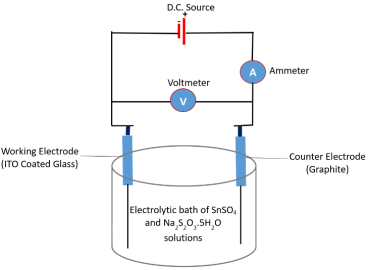
Figure 1. Schematic Diagram of Two Electrodes Electrochemical Set Up Employed.
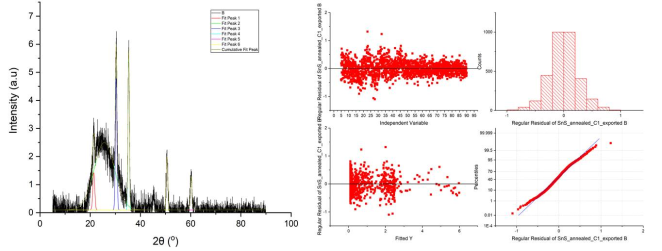
Figure 2. Peak matching and Residual plots.
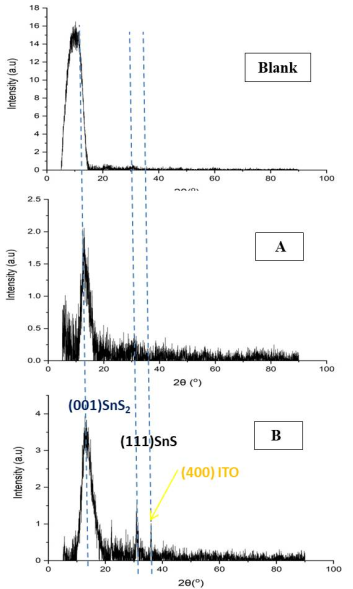
Figure 3. XRD Spectra for the blank and as-deposited thin film samples A and B.
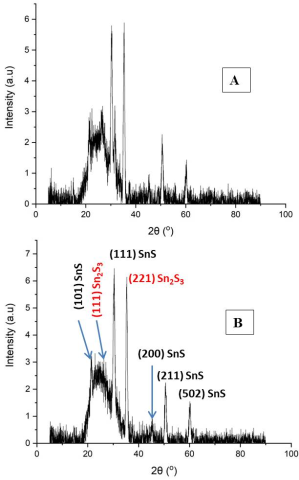
Figure 4. XRD Spectra for the annealed samples A and B at 350°C.
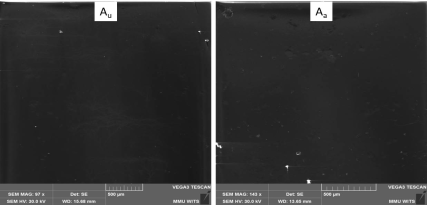
Figure 5. SEM 500 µm Micrographs for Sample A: Un-annealed (Au) and the Annealed (Aa).
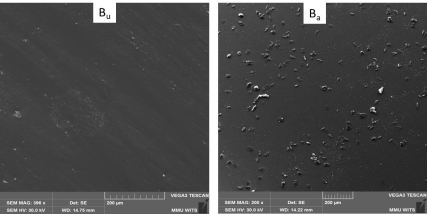
Figure 6. SEM 200 µm Micrographs for Sample B: Un-annealed (Bu) and the Annealed (Ba).
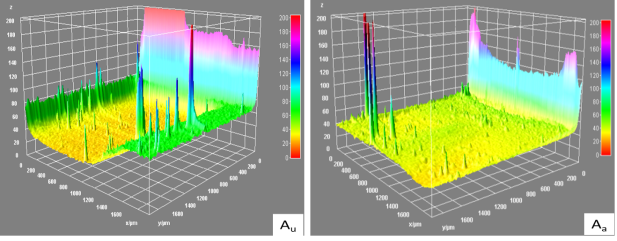
Figure 7. Three-Dimensional (3D) Surface Plots of Un-annealed and the Annealed Samples A.
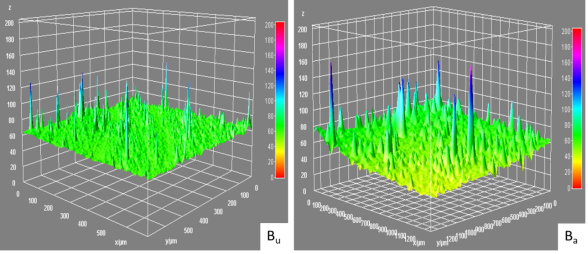
Figure 8. Three-Dimensional (3D) Surface Plots of Un-annealed and the Annealed Samples B.



 Share This Article
 Twitter
 Linked In
 Facebook
 Copy
Copy Download